Sunday, June 15, 2008

In the paper shop

6.30 a.m. today. An elderly man is poring over the pink Lottery result printout in the newsagent's. He's had four numbers come up.

"Drinks are on you, then," I say.

"I've spent £35,000 since the Lottery started, and had five back," he says.

He'd come to the shop at six, having forgotten that it opens at half-past. He thinks he's in the early stages of Alzheimer's.

__________________________________

Here's some lines of comment that could come out of this, but you can easily expand them yourself, I'm sure:

  • Mathematics - the Lottery gives back 45% in prizes, but averaging-out could take forever
  • What is a Government doing, making gambling so easy and readily available (and it started under the Tories)?
  • How much would this man have had, if he'd saved £208 per month since 1994?
  • Now that insurance salesmen have disappeared, what has happened to savings among the C2/D classes? Has financial consumer protection (after the pensions mis-selling compensation and regulation bonanza) indirectly impoverished them and made them more dependent on the State?

I expect you can come up with more, and better.

And then there's drink, from allowing supermarkets to sell it along with your groceries, to 24-hour booze licensing.

Are misguided arguments for liberty being used to enslave people to their weaknesses? Should heavily-capitalised businesses be allowed to batten on those flaws?

Saturday, June 14, 2008

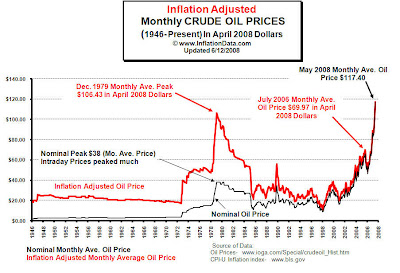
Oil: back to the Seventies

Unbidden, The Time Warp came to me (though I had thought the word "shimmy" appeared in the lyrics). And, of course, as usual, the Brits manage to get themselves into a worse pickle:
Found on Mish's.

Fasten your seatbelts

"Chervil" (author of the Australian Green Living blog) has kindly directed me to this article in the Sydney Morning Herald, which refers to ideas about economic long cycles:

David Hackett Fischer has studied the behaviour and historical meaning of inflation not just over the last decade, or the last century, but over the last 800 years. He sees the world positioned in a dangerous moment of possibility, on the rearing crest of the fourth great wave of inflation in eight centuries.

I would still be grateful for any information about what I shall call "sim economics" - potentially so much more useful than other simulation games.

Anybody able to help, please?

Friday, June 13, 2008

Help required: economic modelling

Following reported opinion from Marc Faber and others that we may expect sell-offs in commodities, bonds, equities and real estate, and given concerns about the quality of our currencies, the question arises, where should we hold our cash?

It seem that in the USA and UK, we are holding down interest rates to avoid crippling homeowners, the home-loan-based economy, and what's left of our industries, and also in the hope that we can repay our debts to foreigners with devalued cash. On the other side, countries like China and Japan seem to be trying to prevent their currencies from appreciating, so as to preserve their trading advantage.

So one party is letting their currencies sink, and the other is trying to stop theirs rising. To this amateur, the world's foreign exchange system looks like a bunch of corks tied to an unchained anchor and flung into the sea. Will the string on the corks hold, or break under the strain, or be abruptly cut?

Is there any computer- or board-game-based model of the world economic system, that might make it clear to me how this wretched thing works?

And how is the ordinary person to save money and preserve its value in real terms, without having to be super-sophisticated? I know something about American TIPS and British NS&I Index-Linked Savings Certifcates, but I'm leery of handing the government what little money they haven't already extracted from me in taxes. And I don't trust them to define inflation fairly.

Does anybody know how this boneshaker of a contraption actually operates, so we can make sensible decisions?

Speaker or silencer?

I now read in The Grumbler that David Davis was prevented by the Speaker of the House of Commons from delivering his resignation speech to the House, and had to go outside the building to say it to journalists instead. Words fail.

Thursday, June 12, 2008

What oil hike?

The Mogambo Guru (too long absent from these pages) points out that a major factor in the increase in the price of oil, is simply the decline in the dollar. We here in the UK don't see it, because the pound is staring the dollar in the eye as both go screaming parachuteless towards the ground.

At least Richard Daughty is one who will not go gentle into that good night.

Now, isn't this what happened in the Seventies? Only we were conned into thinking it was down to wicked Arabs, when really the story was increased monetary inflation for some years pre-1974.

Marc Faber, cash and Cambodia

I said on Monday that Marc Faber was, by and large, in favour of keeping his money in his pocket, and a quick Google News trawl shows that his mind hasn't changed:

Stocks, Real Estate and Oil Are Overvalued, Marc Faber Says

Why rising inflation will trigger a bond market rout

Cambodia Starts to Beckon Private Equity
For investors, Cambodia could be the next Vietnam

The last is interesting. I have suspected for some time that Dr Faber lives in northern Thailand, not simply to hide in Shangri-La but to be nearer to the places where real bargains may be found, and so that his hunches can be informed by personal networking and under-the-radar experience. Quirky and fast-moving, he would not be the man to manage a large institutional fund: I think his lightning ex-ski champ reflexes demand more challenge.

An after-thought: if you do think cash is best, there's still the question of which currency.