At the school where I worked there was an annual expedition-cum-challenge known as the Black Country Tie Night. Those who had passed the ordeal were entitled to sport a tie around the school featuring a foaming mug of beer. Another select club was wearers of the You Lad Tie, conferred on a teacher seen to stop a child in his tracks from a distance with a bellow of “You, lad!”
The Black Country is a region in the English Midlands, so called because it was heavily industrialised and in the old days everything was stained with soot from coal fires and furnaces. Before the recession of the early 1980s the area was still thriving and a key element in working class culture was an appreciation of beer. I remember a crossroads - I think it was in Lower Gornal - that had a pub on each corner.
There were many little breweries and pubs that brewed their own on the premises. Brands included Batham’s, Hanson’s, Simpkiss’ and Holden’s, the middle two now long gone. Some of the hostelries were very simple, not exactly spit and sawdust but certainly bare floorboards. It was in one of these that I saw something I fervently wanted (which is rare for me): a short-haired blue cat, muscular and disdainful of the customers as he made his way between the legs of the chairs and people. The next time I saw such an animal was when a similar one appeared from nowhere to inveigle her way into my mother-in-law's house. Bobby, a British Blue (as I now know), came to live with us for the next twenty years. What a peculiar coincidence; I am afraid to wish for anything else.
It was usual for us to start at the Lamp in Dudley, a Batham’s pub serving a light-coloured bitter similar to a lager but much mellower. Candidates for the tie would be paired with a marker who would check off pints on a beer mat as they were drunk, generally only one pint in each pub. And so the minibus made its tour around the Black Country. The challenge was to drink ten pints without being sick, at least not until after the tenth, which by tradition was always drunk at Ma Pardoe’s in Netherton (she was still alive and brewing back then). That one was served in two halves downed one after the other and then, if necessary, it was off to the gents’ in haste.
One time part way through the evening we bumped into a colleague who was having a drink with friends and asked what we were doing. When we explained he joined in. He was a big Jamaican with a great love of life and famous for his so-called Rocket, a punch prepared with over-proof Jamaican white rum and served surreptitiously to staff in the know throughout the final day of term, which gave a second meaning to the “staggered dismissal” of the children at the end. He was not expected to have any difficulty, even though he had started several pints behind the line; but after a gallon or so he looked stricken and said with tears in his eyes that he couldn't continue. He was most relieved when we clarified the rules for him: he had thought that he wasn't allowed to visit the toilet for a call of nature before completing. Having passed easily, he stayed on for further drinks after the rest of us climbed back on the bus.
The kicker in this challenge was that tie runs were always held on a Thursday so that staff had to come in the following day to teach. One of our colleagues turned up with straw in his hair, having not made it home the night before. The children appeared to be very considerate on the Friday, as I remarked to one of my coworkers, who explained to me that they would remember seeing their dad white-faced in the morning and had learned when it was wise not to provoke.
I never made the tie: I simply haven’t the capacity. Nor did the headteacher, a whisky drinker who asked if he could have doubles instead of beer, but was turned down. Rules are rules.
All is changed. In the ‘80s, secondary schools were male-dominated; now, only one in four of the staff is a man. We have to watch patiently as the women drink Prosecco and dance.
In December 1891, Maurice Baring left Eton early, having shown a talent for languages that had won him the Prince Consort's French prize, and was sent the following January to a German family in Hildesheim, near Hanover. At that time he couldn't speak the language at all, but soon picked it up.
He would go drinking with boys from the two local schools, the Gymnasium (grammar school) and Real Gymnasium (the British equivalent in recent times was the "grammar tech" or "secondary tech", which never really took off as it did on the Continent).
The German tripartite school system was abolished only a few years ago but it's worth noting that the historian Correlli Barnett says Britain's economic decline is partly attributable to the failure to modify its education system to train people who could turn scientific and technological discoveries into profitable commercial enterprises. Too many classical scholars, not enough engineers. Even now, in Britain engineering is a white-collar job, whereas in Germany it's a profession and you put letters before (not after) your name, e.g. "Dr.-Ing".
Drinking culture and customs are a vast area and perhaps readers will offer some thoughts. In the meantime here is how youngsters socialised and learned habits of social adjustment, mutuality and conformity in North Germany in the late nineteenth century. (I have broken the prose into more paragraphs for ease of reading.)
___________________________________________________
From Maurice Baring’s “The Puppet Show of Memory” (1932)
Online: https://archive.org/details/puppetshowofmemo00baririch
The boys from both schools used to meet in the evening before supper at a restaurant
called Hasse, where a special room was kept for them. Braun
was an earnest and extremely well-educated youth, a student of
geology. Before I was taken to Hasse, he said I must be
instructed in the rules of the Bierkomment [I don't know the correct spelling of this word and it is not in the dictionary], that is to say, the
rules for drinking beer in company, which were, as I found out
afterwards, the basis of the social system. These rules were
intricate, and when Braun explained them to me, which he did
with the utmost thoroughness, the explanation taking nearly
two hours, I did not know what it was all about. I did not
know it had anything to do with drinking beer. I afterwards
learned, by the evidence of my senses and by experience, the
numerous and various points of this complicated ritual, but the
first evening I was introduced to Hasse I was bewildered by
finding a crowd of grown-up boys seated at a table ; each one
introduced himself to me by standing to attention and saying
his name (" Mein Name ist So-and-so "). After which they sat
down and seemed to be engaged in a game of cross-purposes.
The main principles which underlay this form of social
intercourse were these. You first of all ordered a half-litre
of beer, stating whether you wanted light or dark beer (dunkles
or helles). It was given to you in a glass mug with a metal top.
This mug had to remain closed whatever happened, otherwise
the others put this mug on yours, and you had to pay for every
mug which was piled on your own.
Having received your
beer, you must not drink it quietly by yourself, when you were
thirsty ; but every single draught had to be taken with a
purpose, and directed towards someone else, and accompanied
by a formula. The formula was an opening, and called for
the correct answer, which was either final and ended the matter,
or which was of a kind to provoke a counter-move, in the form
of a further formula, which, in its turn, necessitated a final
answer. You were, in fact, engaged in toasting each other
according to system.
When you had a fresh mug, with foam
on the top of it, that was called die Blume, and you had to
choose someone who was in the same situation ; someone who
had a Blume. You then said his name, not his real name but
his beer name, which was generally a monosyllable like Pfiff
(my beer name was Hash, pronounced Hush), and you said to him: "Prosit Blume." His answer to this was: "Prosit,"
and you both drank. To pretend to drink and not drink was
an infringement of the rules. If he had no beer at the time
he would say so (" Ich habe keinen Stoff"), but would be careful
to return you your Blume as soon as he received it, saying :
" Ich komme die Blume nach " ("I drink back to you your
Blume ").
Then, perhaps, having disposed of the Blume, you
singled out someone else, or someone perhaps singled you out,
and said: "Ich komme Ihnen Etwas" ("I drink something to
you ").
When you got to know someone well, he suggested
that you should drink Bruderschaft with him. This you did
by entwining your arm under his arm, draining a whole glass,
and then saying : " Prosit Bruder." After that you called each
other " Du." Very well.
After having said " Ich komme Ihnen "
or " Ich komme Dir etwas," he, in the space of three beer minutes,
which were equivalent to four ordinary minutes, was obliged
to answer. He might either say : " Ich komme Dir nach " or
" Ich komme nach " ("I drink back "). That settled that
proceeding. Or he might prolong the interchange of toasts by
saying : " Uebers Kreuz," in which case you had to wait a little
and say : " Unters Kreuz," and every time the one said this,
the other in drinking had to say : "Prosit." Then the person
who had said " Uebers Kreuz " had the last word, and had
to say: "Ich komme definitiv nach" ("I drink back to you
finally "), and that ended the matter.
If you had very little
beer left in your mug you chose someone else who was in the
same predicament, and said : "Prosit Rest." It was uncivil if you
had a rest to choose someone who had plenty of beer left.
If
you wanted to honour someone or to pay him a compliment, you
said " Speziell" after your toast, which meant the other person
was not obliged to drink back. You could also say : " Ich komme
Dir einen halben " ("I drink you a half glass "), or even " einen
Ganzen " (" a whole glass ") . The other person could then double
you by saying : " Prosit doppelt." In which case he drank back a
whole glass to you and you then drank back a whole glass to him.
Any infringement of these rules, or any levity in the
manner the ritual was performed, was punished by your being
told to " Einsteigen " [or " Spinnen"] (or by the words, " In die Kanne "),
which meant you had to go on drinking till the offended party
said " Geschenkt." If you disobeyed this rule or did anything else equally grave, you were declared by whoever was in
authority to be in B.V., which meant in a state of Beer ostracism.
Nobody might then drink to you or talk to you. To emerge
from this state of exile, you had to stand up, and someone
else stood up and declared that " Der in einfacher B.V. sich
befindender" ("The in-simple-beer-banishment-finding-himself
so-and-so ") will now drink himself back into Bierehrlichkeit
(beer-honourability) once again. He does it. At the words,
" Er thut es" you set a glass to your lips and drank it all.
The other man then said : " So-and-so ist wieder bierehrlich "
(" So-and-so is once more beer honourable ").
Any dispute on a
point of ritual was settled by what was called a Bierjunge. An
umpire was appointed, and three glasses of beer were brought.
The umpire saw that the quantity in each of the glasses was
exactly equal, pouring a little beer perhaps from one or the
other into his own glass. A word was then chosen, for choice a
long and difficult word. The umpire then said : " Stosst an," and
on these words the rivals clinked glasses; he then said : "Setzt an,"
and they set the glasses to their lips. He then said : "Loss,"
and the rivals drained the glasses as fast as they could, and the
man who finished first said : " Bierjunge," or whatever word
had been chosen. The umpire then declared the winner.
All
these proceedings, as can be imagined, would be a little difficult
to understand if one didn't know that they involved drinking
beer. Such had been my plight when the ritual was explained
to me by Mr. Braun. I found the first evening extremely
bewildering, but I soon became an expert in the ritual, and
took much pleasure in raising difficult points.
These gatherings used to happen every evening. If you
wished to celebrate a special occasion you ordered what was
called a Tunnemann, which was a huge glass as big as a small
barrel which was circulated round the table, everyone drinking
in turn as out of a loving-cup. A record was kept of these
ceremonies in a book. The boys who attended these gatherings
were mostly eighteen or nineteen years old, and belonged to the
first two classes of the school, the Prima and the Secunda.
They belonged to a Turnverein, a gymnastic association, and
were divided into two classes the juniors who were called
Füchse and the seniors who were not. The Füchse had to
obey the others.
A musical treat! The art of Flamenco is rooted in Andalucia, specifically in the south west in and around Sevilla and Cadiz. It is thought that it came to Spain via the Moors or possibly the Sephardic Jews or maybe because the Emperor Charles the Fifth used Flemish body guards who were famous for their exuberant Burgundian behaviour. In those days the gypsy music was much heavier than the Castillian songs, they called it ‘flamenco’, the name also means Flemish. It is probably a combination of all of these factors and many more. https://en.wikipedia.org/wiki/Flamenco When I first went to live in Madrid many years ago I discovered that the flamenco dance form has its roots in Rajasthan in India where one of the traditional dance forms is called Kathak. http://www.kathak.org/index.php/about/what-is-kathak In recent years many artists in Spain have been rediscovering the origins of their music and dance and have been collaborating with Indian artists and musicians to create a new fusion of the two traditions.
(I had hoped to include video from Prashant Shah and his Kathak/Flamenco fusion but the sound quality was very poor so it can stay hidden in YouTube.)
Over the weekend I watched two very contrasting TV programmes on BBC.
The first, on Saturday, was the City of Glasgow honouring Billy Connolly with three portraits for his 75th birthday. Paintings by John Byrne and Jack Vettriano plus a photograph taken by Rachel MacLean.
Byrne's painting is very good, as one would expect from him. The Vettriano is painted from a photograph (a still from a video in fact) as are all Vettriano's paintings which is why they are all superficial in appearance. MacLean's photograph was a wonderful tribute to the man. Connolly loved all three of them, the generous gentleman that he is.
It was a genuinely 'magical' hour especially when he was with his old friend the painter John Byrne.
These millionaire 'bright sparks' are seriously insane even the one who has run away to hide from the world in the Canadian wilderness. Biggest worry is they all think they are saving the world and building a better future, a phrase they trotted out quite regularly.
The most seriously deranged, to me, was the one who allocated his time very precisely and allowed 35 minutes and no more for his interview with the man from the Beeb. I think I would have asked him rather more difficult questions. He said that work was what people did to earn enough to live and 'have fun'. Such shallow thinking is the opposite of what I tried to outline in my post "What is the purpose of work?" Or perhaps I am the one who is deranged?
The 'runaway' in the Canadian wilderness would have been funny if it were not so tragic. He is there only because our entire civilization created the means to allow him to escape: he didn't build his 4x4 vehicle, he didn't dig the ore nor smelt it nor build the machine tools which created the ammunition he was so proud of - "This will be the currency of the future" he declared. What happens when his 4x4 breaks down? Can he get it going again? What happens when he runs out of ammunition? You could think up countless examples of how other people's creativity and endeavours had given him the means by which he is able to run away from the world he has helped to create and of which he is so frightened.
The most significant thing, in my view, was they are all dodging their tax obligations there at home just as they do in the rest of the world. So it is really just good old-fashioned self-enrichment by lots of snake oil salesmen and some of their business models look suspiciously like 'Ponzi' schemes even better than the derivative trading scams or of Enron!!
Strange world we live in: the benign and the loonies all mixed in together.
I had the pleasure of visiting the Paul
Nash exhibition at the Sainsbury Centre in Norwich on the UEA campus. I have
visited before for other exhibitions but this was a bit hurried as the exhibition
closes on the 20th of August and a couple of “promises” to go did
not materialise.
Nash of course is renowned for his work in
the First World War after he fought on the Western Front and the impact it had
on him which he translated into his paintings.
Between the wars his work changed direction
into the fantastical world and surrealism in many cases using the landscape as
a backdrop to his visions.
At the start of the Second World War he was
employed as the official artist attached to the RAF and produced a series of
paintings of aircraft depicted as aerial creatures in animated positions ready
for action, and then a series of crashed enemy aircraft.
But the interesting painting was his most
famous Second World War work "Totes Meer" (German for “Dead Sea”), painted in 1941.
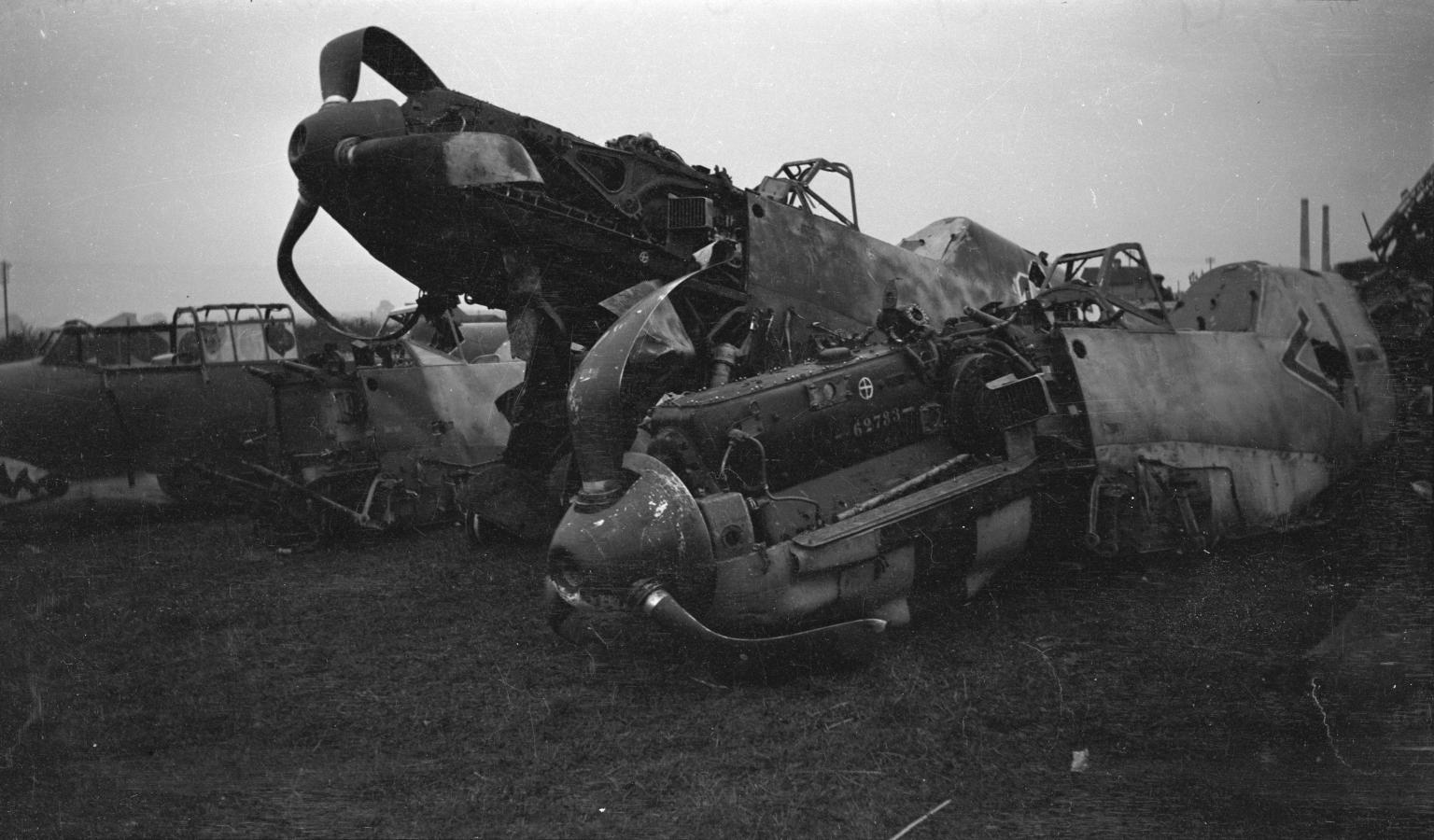
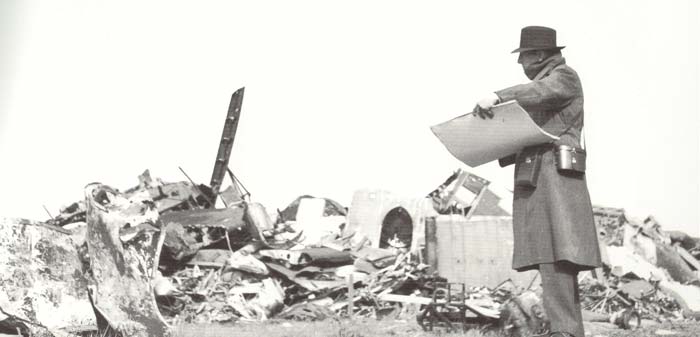
The work was a version by Nash of the
Cowley dump, not one of the most obvious by products of war but a necessary
place for the disposal of crashed enemy aircraft. It also contained as much
British material but Nash focused on the German. It's a place I had not heard of
before and not the only one of its kind in the UK, but it is the one
immortalised in the painting.
It was of course on the site of the motor
works, much of which had been turned over for the manufacturing of aircraft, and
the salvage yard was a valuable resource of materials for refurbishment
cannibalisation and reuse of valuable metals at this time of shortage.
The painting was done shortly after the
Battle of Britain and this is what Nash said of his work.
'The thing (the salvage dump) looked to me,
suddenly, like a great inundating sea. You might feel – under certain
circumstances – a moonlight night, for instance, this is a vast tide moving
across the fields, the breakers rearing up and crashing on the plain. And then,
no, nothing moves, it is not water or even ice, it is something static and
dead. It is metal piled up, wreckage. It is hundreds and hundreds of flying
creatures which invaded these shores (how many Nazi planes have been shot down
or otherwise wrecked in this country since they first invaded?). Well, here
they are, or some of them. By moonlight, the waning moon, one could swear they
began to move and twist and turn as they did in the air. A sort of rigor
mortis? No, they are quite dead and still. The only moving creature is the
white owl flying low over the bodies of the other predatory creatures, raking
the shadows for rats and voles. She isn’t there, of course, as a symbol quite
so much as the form and colour essential just there to link up with the cloud
fringe overhead.'
What also comes out of this story is that
it could be multiplied many times world wide during the war, showing the
incredible production during the war effort, most of which ended up in places like
this or the bottom of the sea.
So a fascinating snippet emerged from my
morning of culture, that I would not otherwise have learnt about, time well
spent.
James Damore, an engineer working at Google, has been fired for circulating a memorandum questioning his company's biases in monitoring and effectively legislating the opinions of its employees:
Interestingly (if you're nerdish), a Google search for this term this morning yielded 690 results, whereas Bing (which usually is far less helpful to me) showed 74,400:
Damore's sin was to suggest that generally, men are different from women and that this affects their work and lifestyle choices.
"Gibson’s series Mirrors Behind the Curtain reveals the self-censored workings of this all-seeing, all-knowing medium. The screenshots in this series are rare glimpses of Google’s elusive Street View camera, busy at work, virtualizing the interiors of different museums, castles, and institutions of power around the world. Unlike normal street view though, in which Google’s car and camera have been easily masked out, the museums’ and castles’ plethora of mirrors present a situation where Google cannot cover its tracks. These images are ambivalent portraits of the often invisible, panoptic power of Google’s observation."