Sunday, July 03, 2022

COLOUR SUPPLEMENT: Bull Run (la fiesta de San Fermin)


https://commons.wikimedia.org/wiki/File:Monumento_al_Encierro.JPG

It is that time of the year again, when the whole world descends on Pamplona (Navarra) in Spain for the Fiesta de San Fermin. The annual 'running of the bulls' has been cancelled for the past two years and I can see from the Spanish media there is an eager anticipation at the return of what is, let's face it, a massive tourist attraction and a very large contribution to the local economy. And I have seen and heard that the running of the bulls will be broadcast live each day as usual via rtve.es https://www.rtve.es/

The fiesta begins on the 6th of July and this moment is marked by a rocket – the “Txupinazo.” All morning, crowds gather in the “Plaza Ayuntamiento” and at midday the Mayor and members of the Council step out onto the balconies of the Town Hall to announce “Pamploneses, Pamplonesas, Viva San Fermín! Gora San Fermín!” (people of Pamplona, long live San Fermín!)

The crowd responds with cries of “Viva!” and “Gora!” and the rocket is launched into the sky. The explosion of the fireworks rocket is the signal for the start of eight and a half days of non-stop partying, drinking, dancing, drinking, eating, drinking, music, drinking, running with the bulls, more drinking until all are too exhausted to continue. (Sleeping is optional)

It is said that if you can survive SanFermin and Oktoberfest in the same year then you are a truly heroic toper deserving of the utmost respect and veneration.


But first, a bit of background to the fiesta.

The Fiesta has its roots in medieval times. Its origins lie in a trade fair, whose existence seems to date from the early thirteenth century. To this fair or market, which coincided with the beginning of summer (festival of San Juan), farmers and cattle traders from the surrounding area brought their animals. The young men of the city joined with the passage of the farmers and drovers through the streets to run alongside them, racing among themselves and these races eventually became part of the festivities. (Probably apocryphal but it makes for a good story.)

Every September 25, on the other hand, the locals honoured one of the co-patron saints of Navarra, San Fermin (the other being San Francisco Javier). And the patron saint of Pamplona is not San Fermin, as many people mistakenly believe, but San Saturnino de Tolosa (modern Toulouse), whose feast falls on November 29. The latter had the honour of baptizing in the third century the early Christians of Pamplona,​ not least among them San Fermin, who become the first bishop of the city. There was also a fair and festival during early autumn celebrating these saints’ days.

In 1591 the day of San Fermin was moved to July 7, becoming part of the the summer fair. Behind this change was the desire of locals to enjoy their holidays in better weather conditions: rain was less likely in July than in September.

The festive program of 1591, organized by the Regiment (Old Town Hall), consisted of a proclamation, a tournament with lances in the Plaza del Castillo, a theatre, dancing and a procession. And, to crown it all, a corrida de toros.

Now, of course, the main attraction are 'los encierros' (the running of the bulls).

For centuries los encierros had no official sanction. It was more of a wild piece of mischief on the part of the young men of the town to which the authorities turned a blind eye. It was in 1867 that the first ordinances were passed regulating los encierros, a name first used in 1856. On that date the current schedule was adopted with a course of about half a mile through the streets leading to the newly built bullring.


On the 7th July at 8am, and on each of the next seven days, six bulls and six steers are run along a course from the corral to the Plaza de Toros.

Hundreds of people take part, running ahead of and alongside the bulls (but mostly after them in truth.)
If you can run half a mile in about two minutes, you should be able to keep ahead of them, or at least alongside for part of the way. If you wish to try to outpace the bulls you will need to be young and fit and healthy and preferably an Olympic class athlete. Half a mile in just over two minutes? In a large crowd of runners who are mostly looking over their shoulder rather than where they are going?

There is a (remote) possibility that you will die (there have been sixteen fatalities since 1910.) The gory details are here - https://www.sanfermin.com/en/running-of-the-bulls/a-tragic-history-deaths-running-of-the-bulls/ )

There is a slight possibility that you will be injured and such injury will come, not from one of the bulls, but from not looking where you are running and tripping over those who have already fallen. It can at times be like an obstacle course as you can see in this video from 2019 -


But there is more to the fiesta than the running of the bulls and you can read about it here. - https://www.sanfermin.com/en/

And when it is all over and it is time to say goodbye for another year we come to “Pobre de mí”, the End-Ceremony of Sanfermin.

At midnight on the 14 th July the fiesta formally closes with the ceremony called the “Pobre de Mí.” This takes place in front of the Town Hall, where the fiesta was opened 8½ days earlier. There are other events also taking place in the city, (such as the Peñas gathering in the main square – the Plaza del Castillo, for their own celebration).

However, in front of the Town Hall a large crowd gathers to sing “Pobre de Mí, Pobre de Mí, que se han acabado las fiestas, de San Fermín.” (Poor me, poor me, for the fiesta of San Fermín has come to a close).

This is a very sad occasion because it is the end of the fiesta, (though many are relieved because of their flagging stamina they cannot take any more), but they still look forward to next year and even sing “Ya falta menos” (there is not long to go).


The best guide to it all comes from Alexander Fiske-harrison who wrote a book called 'Into The Arena' a few years ago which is an exceptionally good book. It tells the story of his journey into the world of the corrida and how he trained as a bull fighter to eventually facing a toro bravo in the plaza de toros.
This is his web page - https://thelastarena.com/ and here he is giving his reasons for his interest and involvement in tauromaquia:

Saturday, July 02, 2022

WEEKENDER: Merde, by Wiggia

                                      Very Annoying Things or Modern Life as we Know It

Much of today's life contains items that enhance and help our daily trudge through the merde.

We would find it difficult to envisage a world without the internet, yet the internet brings its own bugbears, communication, internet shopping, alternative news outlets, online services; all were greeted with smiling faces as we embraced the ease by which we could do things from the comfort of one's own home and later, on the move with the advent of smart phones.

But convenience and simplicity soon gave way to added complexities, especially in the banking sector where one now needs a degree in software if anything goes wrong as the banks more than others have pushed inadequate security onto the customer. Having to interact with a smart phone just to get into a bank account online is not simplicity and if you lose a password you can spend a morning righting that mistake: the whole password, username, favourite dog saga with all accounts has reached nonsense level and who could possibly remember them all.

Don’t write them down we are told, yet the alternative, the computer based password storage vault, is we are told very hackable so maybe better to have endless slips of paper somewhere with all numbers digits etc. on them, I actually had a Microsoft ‘update’ that managed to wipe all my stored passwords and much else, so I was grateful for the slips of paper I did have at the time.

Much of the above is magnified by the inability to correct by speaking to an actual person, someone unintelligible in Mumbai or Scotland as happened recently is about the last straw after a morning going in circles on the internet.

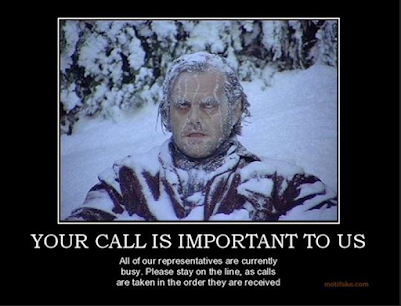
Even a phone call is fraught with options you don’t want, don’t need but you get anyway. A classic happened a couple of weeks back with a Building Society: after all the options were listened to in three separate batches my problem was not among them, so I plumped for the ‘any other business‘ only to be told after pressing 6 that this option had been removed, please use the web site I had just left in desperation... and then I was cut off; rinse and repeat.


Some companies go out of their way to be considerate: they will provide a ring back service, though if you do not have a smart phone (how dare you!) you will have to stand by the phone for up to 24 hours as they will not define a time.

My surgery phones occasionally, but never about anything other than 'have you had your eighth booster as you are on the extremely vulnerable list.' The NHS itself sends letter telling me my ‘spring’ booster is due in June; still, they tried. The cost of all these unwanted calls and letters nationwide must be equal to the defence budget.

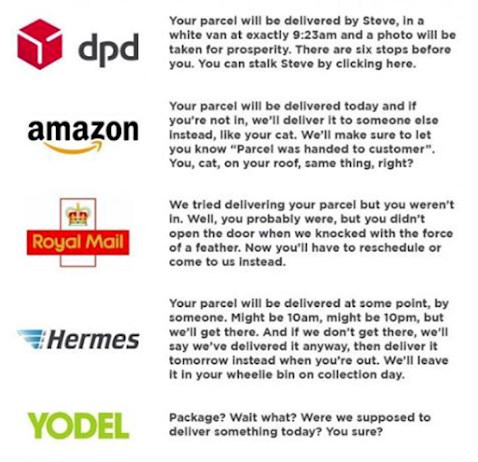
The convenience of online shopping brings with it the lottery of who will delivery your “urgent” parcel. We have a postman, the regular one who nice chap though he is! leaves endless cards saying he tried to deliver but no one was in, please arrange re delivery; yet my study is eight feet from the front and the loud door bell and despite being present I have never heard the bell or a knock on the door; bizarre.
They also have advanced technology where they can detect if you've just sat on the toilet, giving you just enough time to watch the van pull away forever...

The delivery companies all have their own rules and in fairness one or two are excellent in most respects. Sadly some of the cheaper ones are not. I have great sympathy with delivery drivers who to make a living drop over 150 parcels a day so I can’t blame them for mistakes caused by too many drops but I can blame the inadequacies of the companies and their attitude - early Yodel, anyone? or the same with Hermes: as soon as the delivery company was revealed to be either of them it was nail-biting time as to whether anything would arrive at all.

The convenience of online shopping has usurped going to a shop and trying on clothes and footwear to see if they actually fit. It is often used as a lazy shopper's route to the wrong items. With clothes and footwear sizes being a lottery these days how anyone can buy these items online and expect them to fit without trying them on amazes me. The fact that there are easy return options negates the ‘easy shopping’  as you may as well have gone to a shop on the high street tried whatever it  was you wanted on and saved the extra trip to the post office to return the item, which is normally jam packed with eBay sellers wanting to post a hundred or so individual items.


Bureaucracy used to be a problem the French had. Not any more, we have in many areas left them well behind. Whatever you do don’t die, or any of your near and dear, the cost and form filling is only there to further reduce the population. Having had to go through the so-called formalities several times in recent years it gets no easier. If you think you are in danger of popping your clogs in the near future transfer all you can now to your spouse and save a lot of time and money and having to deal with stupid seat warmers who try and justify their position in life.

I can add to that, forget the expensive funeral that is for everyone else other than the poor sod who has died; he will probably be paying for it all and that will come from the estate. What is the point? Once you have popped off no one cares anyway, only about the will and its contents. Don’t forget, the large scotch being lifted in your name at the wake is being paid for by you

On a more mundane level, nothing can be repaired on a vehicle without replacing the whole unit; sometimes, as with a cam belt change as I recently found out, they expect you to replace the water pump at the same time. Why? Because it is easier when replacing the cam belt. This scam is now almost universal. They now want to replace items that are perfectly sound and have years of life left.
While talking about cars, mine, which I am reasonably happy with, has auto stop start; the stop start achieves nothing in improving frugality unless you drive in town a lot and requires a bigger battery and starter motor which naturally are far more expensive to replace. I do have the ability to turn off this feature, but why do I have to do this every time I start the car? They have menus for everything else I never use, but this no, is it done just to annoy us.

Not that many years ago there was a campaign to change or replace plastic packaging. No problem with plastic packaging other than the items you can’t open: I recently had a tool delivered wrapped in a blister pack; there was no way in without resorting to using garden secateurs, and even then the plastic bubble was so resistant I had to cut the whole thing into pieces as it was impossible to tear. The same goes for plastic bottle caps with the tear strip you can’t even get hold of, never mind remove without pliers and strong arms. There must be arthritic little old ladies all over the country with cupboards full of unopened plastic bottles and if it is medication they could well be dead; perhaps, as with so much for the elderly, that is the intent.

The same goes for the foil top under the top on milk cartons. The tab is made deliberately small and stuck down so hard that one has to puncture the top to get at the milk, which rewards you by splashing over you and the work surface.

I recently replaced a can of WD 40, one of those essential items in the garage or home. For reasons unknown they have altered the plastic top on the can. You need this as it also holds the small item for fixing the oil tube to should you need it, but the new top cannot be removed without it flying into space complete with widget; now they sit separately on the shelf, waiting to be lost somewhere.

Sachets that come with items like stir fry, containing oils and seasoning, demand the use of scissors to open them. Others have ‘handy’ tear-here arrows, only when you tear the sachet remains closed as the tear line is in the wrong place; scissors are then used and the smaller sachet then squirts oil everywhere. There is a similar problem with a certain bank for whom I do not use a direct debit: the monthly statement contains a tear-off paying-in slip, but the tear line is in the wrong place and has been for years and when you attempt remove slip from the page you tear the slip in half; marvellous.

And talking of packets and similar, why do they print instructions or contents in such small print it is impossible to read without a magnifying glass. Even some instruction manuals are like this; printed in a dozen languages may save money as opposed to separate language versions but to do this cheaply they squeeze minute print onto fewer pages, usually into a manual the size of a fag packet.
 
And have you had a feedback request from Amazon about their packaging and how they have changed to more ‘sustainable’ boxes? This usually comes after you have received a three-foot box stuffed with brown paper to stop the ink cartridge you ordered rattling around. “How are we doing?” is usually the opening question - I have never answered!

It is interesting that the switch in 2030 to all electric vehicles coincides with adverts telling you they are faster than equivalent petrol models and do 0-60 in two seconds, when the only thing that matters is are they affordable - no! And what is the battery range, which is better but you still won't find anywhere to charge en route, and those that do exist won't fit your car and/or charge exorbitant rates. Get used to it EV owners, the honeymoon is over: road tax next or road pricing, so the cost of motoring will be no cheaper but less convenient and you will have paid a lot more for the car in the first place.

All vehicles are sold by stating performance or frugality depending on your use of vehicle, but performance figures for new cars are now pointless as all are now fitted with speed limiters, so a car that on paper does 140mph in reality does 70mph unless you use the override, and that is recorded; the sports car has been reduced to a fashion item.

Anyone who thinks that does not apply to them and their pre-limiter ICE sports car should remember that the road conditions these days limit you in many cases to a lot less than 70mph so the eco brigade are winning, making it ever more frustrating trying to actually go anywhere. I saw a Ferrari on the road where I used to live having to go from side to side to get over the speed bumps, so high are they; normal cars just straddle them which defeats their purpose, but low riding vehicles have to resort to snake like manoeuvres to get up the road and of course if there is heavy traffic they have to wait for it to become clear and hold everyone behind them up in the meantime. To coin a phras, a Ferrari round here is about as useful as a chocolate tea pot.

With roaring inflation energy prices going through the roof and the prospect of WWIII round the corner all the above becomes marginal in importance. Still, enjoy what you can when you can, the music festivals are in full swing and a new boy band has appeared at Glastonbury, that should cheer all up - oh, wait a minute…

The obvious question with this photo is who thought it a good idea to go all Alan Partridge and be tieless? Do they really believe this will endear them to the general public? And in the case of Boris, is he wearing a tail coat or worse? We have every right to be seriously worried by those who pretend to run things.

Not the Magnificent Seven, nowhere near!

Friday, July 01, 2022

FRIDAY MUSIC: Bruce Springsteen and The Sessions Band, by JD

I think the best way to desribe this music is to say it is a blend(?) of New Orleans style jazz with folk music playing very old melodies which form the bulk of what can be loosely decribed as 'Americana.'

It works simply because, as can be seen from the following videos, all of the musicians involved are playing from the heart and loving every minute of these exuberant performances!


Wednesday, June 29, 2022

Abortion, law and liberty

From Sackerson's 'Now and Next' on Substack:

Friday’s US Supreme Court (SCOTUS) ruling on abortion has split the people, as though America did not have enough causes of internal strife already.

In the USA the law is complicated by the interaction of the Federal Constitution and the law-making bodies of its fifty member states, each of which has its own Constitution and body of laws. Several States prepared for SCOTUS’s judgment in advance and treated it as a starter’s gun, so that they could immediately set about modifying their own abortion laws.

State legislators run the risk of framing simplistic rules for ethically complex cases. For example, in Ohio, by sometime next year the only exception to a total ban on abortion may be if the mother’s life is at risk; rape cases may not be exempted. The Senate President has said:

A baby is a baby even if it came through some terrible awful thing like rape. The answer can’t be let’s just kill the baby.

In the UK there was a legal test case on just that, long before the 1967 Abortion Act. As journalist Peter Hitchens relates, in 1938 a Dr Aleck Bourne performed an abortion on a 14-year-old girl who had been gang-raped. He reported himself to the authorities for a trial that could have earned him a life sentence but was acquitted because, the judge said, the pregnancy would likely have made the girl ‘a physical and mental wreck’ and the doctor was ‘operating for the purpose of preserving the life of the mother.’

Yet Dr Bourne opposed the call for abortion on demand, saying it would be a ‘calamity’ and would lead to ‘the greatest holocaust in history'. Asked by other women for an abortion, thinking he would sympathise, he refused and later recalled,

I have never known a woman who, when the baby was born, was not overjoyed that I had not killed it.

In the US the Supreme Court tried to mediate the conflicting laws of the States on abortion with its 1973 Roe v Wade ruling, based on the implicit Constitutional entitlement to ‘privacy’ (the right to make personal decisions principally affecting oneself.)

SCOTUS went into further detail, laying out what States could rule on during each of the three trimesters of the pregnancy; this judgment was extensively modified by another, 1992, Supreme Court case, Planned Parenthood v. Casey (1992.)

The latest SCOTUS has now overruled both those cases in Dobbs v. Jackson Women's Health Organization, saying that there was no reference to abortion in the Constitution, because the Founding Fathers drew it up nearly 250 years ago.

That is what is known as an ‘originalist’ interpretation and raises questions about whether the Constitution needs updating. Thomas Jefferson himself suggested (July 12, 1816) that each generation should be able to revise it for their own needs:

By the European tables of mortality, of the adults living at any one moment of time, a majority will be dead in about nineteen years. At the end of that period, then, a new majority is come into place; or, in other words, a new generation. Each generation is as independent as the one preceding, as that was of all which had gone before. It has then, like them, a right to choose for itself the form of government it believes most promotive of its own happiness; consequently, to accommodate to the circumstances in which it finds itself, that received from its predecessors; and it is for the peace and good of mankind, that a solemn opportunity of doing this every nineteen or twenty years, should be provided by the constitution; so that it may be handed on, with periodical repairs, from generation to generation, to the end of time, if anything human can so long endure.

Jefferson saw the Constitution as founded on the will of living people, and assumed the possibility of communal assent. But what if the law is highly controversial and the authorities are felt to be promoting a one-sided political agenda? How can citizens influence their State?

Many people feel the system is rigged: some States gerrymander constituencies and also make it harder for typical Democrat supporters to get to polling stations. In any case, the periodic choice between two party policy menus is a crude form of control.

Worse still, the parties may agree on some issues, so there is no real choice anyway. For example, the Republicans have long had trimming social security benefits in their sights, but Biden the Democrat has just appointed Andrew Biggs to the government’s Social Security Advisory Board; Biggs may help steer a changeover from the State-guaranteed pension to an investment-related product that stands to make a fortune for Wall Street while exposing the citizen to market risks.

In relation to abortions, Biden can’t countermand SCOTUS but made reassuring noises about individual rights implicit in the Constitution he is sworn to uphold, relating them to the chance to vote for his party in November’s elections:

The right to privacy, liberty, equality -- they're all on the ballot. Until then, I will do all in my power to protect a woman's right in states where they will face the consequences of today's decision.

In this case, a key right is freedom of movement. Some legislatures are already seeking to criminalise those trying to go out-of-State for an abortion, and anyone who helps them. Ironically, US Supreme Court Justice Brett Kavanaugh, whom a man allegedly planned to assassinate because of the leaked draft judgment, has already indicated that he would rule against the attempt to impose travel restrictions.

The people are impatient, so much so that one wonders if the slow and complex machinery of institutional democracy can work. Initial reactions include calling SCOTUS ‘illegitimate’, mass screaming and twerking, shouting ‘f—- you, Supreme Court!’ at an LA awards ceremony and personal threats against the Justices.

One can understand the frustration and sense of powerlessness. The State has become over-mighty; the Constitutions of the USA and of Britain (who led the way) were designed to limit the power and influence of the Executive. Yet the modern technocratic State (and its Silicon Valley friends) now intrudes far into our privacy, supplying information to the policymakers, the behavioural ‘nudgers’, law enforcement agencies.

Maybe there is too much law. In 2019 the US Code listed over 5,000 different criminal offences; and that’s just federal law. The more laws that are created and the more we call on the police, FBI etc., the closer we get to a police state.

If we value the liberty of the individual, we must learn not involve the authorities in every matter. Instead of framing and enforcing criminal laws on one another, in some cases we should revive the practice of moral suasion; argue and listen, prepare to modify our opinions, sometimes agree to disagree; but refrain from blowing the whistle.

Sunday, June 26, 2022

COLOUR SUPPLEMENT: The Golden Section

This was first posted at Nourishing Obscurity on November 24th, 2010 but was lost along with a lot of other posts when James had his WordPress 'crash' It followed on from one of his posts titled The Mathematical Precision of the Universe and was also a clarification of a BBC programme which is still available on their iPlayer.
----------------------------------------------------------------

I am prompted to continue the theme after watching a programme on BBC4 last week about Leonardo da Vinci’s drawing of Vitruvian Man. http://www.bbc.co.uk/programmes/b00vl3h1

I found the programme to be dumbed down and, in parts, risible. Most unsatisfactory and it wasn’t clear what point they were trying to make.

So allow me to make it for them.

The BBC described this as a puzzle. It is not a puzzle and never has been. The relevant passage in Vitruvius is very clear.

Leonardo abstracts it on the drawing in mirror writing and it is here -https://www.geoman.com/Vitruvius.html

Although this passage is in the section on Architecture it is really about the proportions of the human body and then it continues to show how architectural design should follow the same rules.

Leonardo drew a man in the correct proportions (and his notebooks carry several anatomical drawings to illustrate the proportionality of and within the body) inside a square.

Then, in accordance with the description in Vitruvius, he placed a compass point on the navel and drew a circle around the figure. Following which he placed the two additional arms and two legs fitting within that circle.

This is why the square and the circle are offset.


The navel is indeed the centre of the circle but it is not the centre of the square. Look very carefully and you will see that the navel bisects the square at a point 0.618++ between the top and the bottom of the square. Thus, the human figure is divided at the navel by the Ø ratio (Phi) otherwise known as the Golden Section. And here we begin to see the importance of this Golden Proportion. It occurs naturally in the human figure.

This is shown in the next drawing, an analysis of Leonardo’s.


If we take the side of the square and thus the height of the man and divide it into 144 parts then it can be seen that the distance from the feet to the navel is 89 and the distance from the navel to the top of the head is 55 and the distance between the top of the square and the top of the circle is 34. These are all numbers arising in the sequence of Fibonacci numbers and, just as these numbers are related to the Phi ratio, so the body is defined by this same ratio. https://en.wikipedia.org/wiki/Fibonacci_number

Why use 144 as a base measurement? The answer is, again, in the book by Vitruvius. He states that the ideal figure is 6 foot tall; which divides into 72 inches or 144 half-inches. Leonardo, in his notebooks, made further study of the human frame and always with reference to Vitruvius because that book contained the necessary clues. He found that the body was perfectly proportioned in terms of the ratio expressed by the Golden Section.

For example; the finger joints are related to each other and to the hand and arm in exactly this Ø ratio. Leonardo concluded that this ratio is the one which expresses growth in the human form. This is confirmed by the place of the navel at the precise Ø point between the head and the foot. The navel, of course, is the point at which we all commence our lives. We all begin as a germinated seed in the womb, connected to our mothers by the umbilical cord. Growth begins at this central point, the navel.

All of nature grows in exactly the same way. Everything from a human embryo to the spiralling galaxies in the universe follows the invisible rules of the Ø ratio.

As James said, this points to the mathematical precision of the universe.

Marcus Vitruvius Pollo knew it, Leonardo da Vinci knew it and the poet John Dryden knew it-

'From harmony, from heavenly harmony
This universal frame began:
From harmony to harmony
Through all the compass of the notes it ran
The diapason closing full in Man.'

John Dryden (1631-1700)


……….to be continued…………….

Saturday, June 25, 2022

WEEKENDER: More on the failing NHS, by Wiggia

There is a certain inevitability about getting old: we need more help on the medical front than of yore, none of us like to admit it but there it is. The argument about whether certain treatments that extend life are really worth the cost in monetary terms or personal life quality is a separate argument.
Still, by its nature the state of our health service does take a very elevated position in our thoughts in everyday life for obvious reasons, so inadequacies in that health service have a serious impact on our lives.

There seem to be endless stories in the press about the NHS on an almost daily basis. None of them put the organisation in a flattering light, which is hardly surprising considering the state it is in,

Nonetheless one would like to think that they were trying to right the wrongs and at least try to serve the public they are there to supposedly look after in times of medical need and not add fuel a fire that just keeps burning.

An example was this week when my wife had to go to the reception at our ‘Medical Centre’ to correct a prescription that had on two occasions been issued with the wrong medication; no good phoning unless you have an afternoon to spare.

On the receptionist's desk was a notice telling those who approached that they had been receiving abuse and threats and anyone who persisted would be de-listed.

Now no one can condone threatening behaviour, yet one would think that the surgery, sorry, Medical Centre would readily admit that people's frustration at not being able to even speak to a doctor (especially if you work for a living) is becoming ever more intolerable and that the centre's policy of working two days a week with ever fewer staff while taking on more paying customers, just might have something to do with it. Tthe threat of de-listing, not that it would make much difference currently, is not a solution; it is a pound shop solution to a problem not of the patient's making, and at surgeries like ours there appears to be no visible effort being made to correct things or redeem the patient's faith in the service, such as it is.

They even shut down routine testing a short while ago, already months behind schedule as the ‘staff’ were busy outside the surgery giving Covid jabs for which they are paid extra. Not bad, working two days a week and then being able to junk even that and go elsewhere to earn more all at the public's expense both in monetary and medical terms.

And now along with much of the public sector they are talking of taking strike action. Much of this comes from a basis that all were heroes during the pandemic and we should just cough up. There is nothing wrong with people wanting a pay rise, but consider two things: the bulk of the NHS was on holiday during the pandemic, so it hardly warrants the hero status; and secondly, the drop in earnings since 2010 of 22 % affects everyone, they fail to realise it is not about ‘cuts’ but a general drop in wages and living standards for many, most without the comfort of public service blanketing. We cannot assume all wages will just go on rising because we want it; economics comes into it and the private sector workers have suffered a lot more than the public sector and they of course provide the funds for the public sector to exist on.

The NHS consumes an awful lot of wonga. They can argue it is not enough but we can say much is badly spent and the figures can be made to show almost anything that is needed either way. When comparing international health spending I see we measure up very badly: infrastructure - poor, beds available - worst, doctor-patient ratio - very poor and many clinical outcomes - poor. Not all of that is because of lack of funds.


There is no way we can claim to be grossly underfunded in health care. Many countries that spend less better outcomes,  better patient to doctor ratios and more hospital beds, as well as better outcomes in the treatment of cancers for instance. Yet many use the US model as the reason not to change; I can only assume they have a socialist agenda and defend their baby regardless of current failings.


Our GPs are the best paid in Europe apart from Germany yet have the worst ratio of doctors to patients and still get paid for not seeing anyone; there is something seriously wrong there for a start.


We have fewer hospital beds per thousand population by a mile, far less than almost any Western country. Fewer beds means fewer patients in care so fewer medical staff needed, yet somehow we are always needing more. I repeat, how can the biggest employer outside the Chinese army be short-staffed? Answers on a postcard please, though I think we know the answer to that.

The chart below shows the decline in available beds, during a period when the population has increased by at least ten million. If anyone can explain the logic of that vis-a-vis other countries I will be astounded.


The NHS trusts should not be personal fiefdoms; all should be under the same umbrella on strategy on spending and structure. Many areas of the NHS still manage to provide decent services; how come others have been allowed to throw the towel in and be unfit for purpose and remain so?

Those who always say we are better off rather than following the US model are not comparing like with like. Why they always bring the US health service into the discussion is strange as there are so many others that have better results than us with similar expenditure. Again, the insurance portion of the cost gives patients the right to choose, something drastically missing here. This is the Danish model: see PT2 for patients' rights and tell me it is not better than our system.


It seems that no matter how many people put forward proposals for improving our NHS nothing of consequence changes. The current waiting lists are so long many will give up and many will die; not a lot of applauding in that sector.

You could almost do a weekly piece on the NHS failings, it just goes on and on. I shall cease for a while. What we see of and get from that organisation stays the same, however much we protest; sometimes it feels as though only a nuclear strike could change it.

Friday, June 24, 2022

FRIDAY MUSIC: Claire Pommet, by JD

Claire Pommet known professionally as Pomme is a French singer, songwriter and musician.


----------------------------------------------
This is her YT channel with lots more excellent music 'pour votre plaisir':

Monday, June 20, 2022

'Now and Next': did you miss these?

Keep up with a FREE email subscription on Substack !

June 8 - 14:

Quiz Night
A fun evening at the pub

Our money is rotting
... and has been doing so for over 100 years

Ukraine: a doomed neocon cattle-raid
The robbery of a poor country with rich resources

Baron Munchausen 2
A translation of the earliest (tall) stories

'You will own nothing...'
... being happy, that's another story

Ukraine is finished - Lira
But what happens next?

Saturday, June 18, 2022

WEEKENDER: We Approach Midnight, by Wiggia

We suffer the recent transport problems where no one it seems can leave the country by air, the railways are to expensive and on strike anyway and the price of petrol is prohibiting much car travel, but there is an answer…


So staying at home takes on a whole new meaning, not that different from the imposed lockdown conditions.

Several government statements were issued this week in the hope one or another will bolster Bojo’s decline; they won't, and they are no more than statements. One about the ‘houses for everyone’ will soon dispel any illusion that this is anything other than an ill-thought-out idea or simply a piece of propaganda being issued on the premise ‘we are doing something.'

The original ’right to buy’ scheme under Margaret Thatcher was at the time seen as a great way to get people on the housing ladder. This was achieved by discounting the council properties the buyers lived in and impoverishing the councils who had little in return to replace those same lost council properties built with taxpayers' money. Replace them they didn’t, resulting today in waiting lists for social housing that only the NHS can compete with.

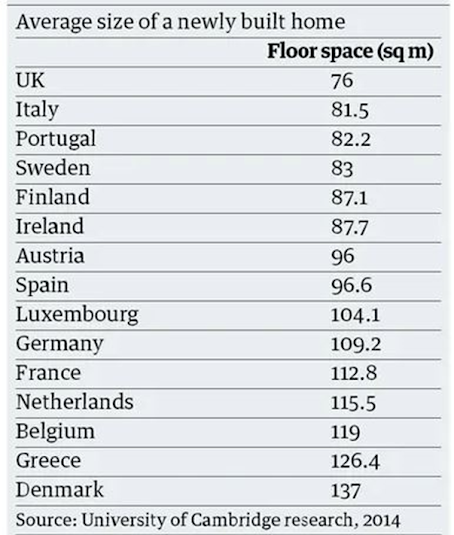
Only desperation would make anyone want to buy the smallest housing builds in Europe and they are getting smaller: average houses in the Twenties were roughly twice the size, plus a real garden.


The only people to gain, and why not, were those offered their council properties at the bargain discount prices who then sold on later at market rates and made a killing. Once again the taxpayer and the council lost out.

This time, being a scheme under Boris’s reign the facts are far from clear - 'mud' is too kind a word - and maybe that is the point: it is just a statement boosting (he hopes) his kerbside appeal in times of strife.

Before looking at it, one has to ask why are we building so many rabbit hutches in the first place. 'Not enough and too slow' is the cry that goes up, yet the indigenous demographic is static, so any demand is being caused by the fact we have 7 million extra people in the land since 2010; and who created that problem?

One's first reaction is to ask how do people on benefits qualify for a mortgage? If they have enough for a deposit they don’t qualify for benefits; or are we missing something?

Secondly, this applies not just to council properties but housing associations and, if the wording is correct, privately owned properties in the letting market. The latter can’t be true as the government is discounting these properties, and how is the private sector going to take a discounted hit on the selling price? This has to be nonsense.

However, critics have pointed out that Universal Credit is only available to families with less than £16,000 in investments and savings, meaning they would have very limited access to mortgages, or in the real world, none at all.

Most lenders ask a minimum of 10 per cent deposit. Levelling Up Secretary Michael Gove indicated the government was looking at creating a savings vehicle that would not count toward the benefits limit, but it is unclear how that would work or how banks would be made to accept the handouts in their calculations.

The housing association position is more serious. With so little social housing being built by councils, housing associations have been taking up some of the slack; to hit them with this scheme would be a disincentive to build any more new units - what would be the point?

In fact the more one looks into it the more it becomes fantasy…


Above all it would require those who have worked hard and saved for their own homes to be subsidising a scheme for those on benefits to reap the rewards of a cheap home they cash in on later.

“Downing Street said there will be a 'mortgage review' looking at how low-deposit mortgages could be extended.“

There are already many ways mortgages are propped up by assistance to those on benefits, all explained here in this handy editorial:


I never thought I would see the day when a government would promote sub-prime mortgages after what happened not that long ago; for that, dressed up in a different way, is what this is.

The banks have already said they are not going with this as it stands.

This parody is spot on…


So what are we to make of it? Is it a serious effort to get people on the housing ladder, or just hot air? Judging by other government statements this last week the latter seems more probable. At this rate, future governments will make mortgages redundant and all new homes will be given to those who cannot afford them and thereby save all the paperwork involved in current schemes. 

Bearing in mind warnings that our hallowed housing sector is due for a fall, all this will become tomorrows fish and chip wrapping, and we will move on to Bojo’s next wheeze.

Friday, June 17, 2022

FRIDAY MUSIC: Albert Ketèlbey, by JD

Albert Ketèlbey (1875 - 1959) was an English composer, conductor & pianist born in Birmingham. He became famous for composing popular light music, much of which was used as accompaniments to silent films, and as mood music at tea dances.

You can read a full biography here - http://www.albertketelbey.org.uk/albert.html


This third video is Ronnie Ronalde whistling over the melody. He was never off the radio in the fifties and was popular with my parents' generation; maybe not popular but certainly different!


Monday, June 13, 2022

New Substack articles !

See what you missed on 'Now and Next' - subscribe and share if you like!

June 1 - 7:

Boris Johnson's mock-Imperialism
He waves the flag but he's a chancer

Private Eye: from satire to propaganda
The magazine has lost its balance over Ukraine

Ukraine is a distraction from service to the people
The US needs a bogeyman to disguise domestic failure

Monarchy and national integration
Never mind the miserygutses, the Jubilee helps unite us

Baron Munchausen 1
The first of the original tales, in a new translation

Pounds and ounces: power to the people
Why the old measures actually work better

Zelenskyy's kill list
He didn't start it, but he's not stopping it


Sunday, June 12, 2022

COLOUR SUPPLEMENT: Inch Perfect, by JD


There was last week an article on the web site TCW - Defending Freedom about the restoration of our traditional pounds and ounce which had been made illegal by dint of our membership of the European Union.

"BORIS Johnson’s proposal to restore pounds and ounces and the crown mark on pint beer glasses may be opportunist populism from a cynical chancer, but much of the imperial system of weights and measures worked better than metric.

"That’s because it was rooted in what people found useful. By contrast, the rule of ten was imposed from above in the French Revolution, a politically-driven programme to cut us off from our past and begin afresh; progressivism is about centralised power versus the populace."

https://www.conservativewoman.co.uk/in-praise-of-pounds-and-ounces/

Let's hope this is the beginning of the restoration of all of our ancient and customary units of measurement which are indeed rooted in what people found to be useful and practical (politicians and academics are invariably lost in their own little world which is governed by theories and are woefully unfamiliar with anything practical).

The next step surely is to restore the inch/foot basis of our built environment; something which never really went away if truth be told.

The following is the text of an article written in October 1995 for 'Perspectives on Architecture', a magazine dedicated to traditional architecture and to the craftsmanship required for the preservation and maintenance of our built environment. 

The article was timed to coincide with the British Government's compulsory use of metric measurement for all goods and services in the UK, a legal requirement which is widely ignored and disliked by the majority of people. The article is a reflection of the merits or otherwise of its use in the building industry where it has been compulsory for 30 years. 

For reasons best known to the editors, the article was never published. It would seem that their commitment to traditional values does not include that most fundamental of requirements in the construction industry; i.e. the practical use of measurements to transcribe drawings into real life buildings.

-----------------------------------------------

In 1965 the building industry decided to change to the use of French Decimal measurement, commonly known as the Metric system. Thirty years on and with the rest of industry now obliged to follow suit, perhaps it is time for a progress report. No one seems to have asked yet; has it worked? Is everyone happy with it? Is it easier, as the metricators claim, or is it harder? Is it better than the traditional system, or worse?

Working in the industry, I went along with this idea at the time without giving it much thought. In those days people still had faith in politicians and business leaders and believed that they knew what they were doing. (The events of these last two years, 2020 - 2022, has definitely shattered that particular illusion!) Now that I have spent a number of years studying the history of architecture and of building, I have discovered how and why we arrive at the measurements we have always used.

The first and most striking thing about the 1965 change is that there has been no change. The industry carried on using and continues to use the same materials in the same sizes but with different unit values. Thus a brick is still 9" long but is now designated as 225mm. The standard door size remains at 6'6" x 2'6" but now has what appears to be a code number of 1981x762mm. Why is this? Where are the materials/components which are whole units of 1 or 2 metres or natural multiples/divisions such as 250mm or 500mm? There seems little point in adopting a system of measurement whose basic unit is incompatible with the building process in terms of sizes required to build a house, for example, which is correctly proportioned relative to the size of the people who live in that house. After 30 years, it is apparent that the metric unit of 1 metre is too large and 1 centimetre is too small to be used comfortably in the building process. This is relevant in the rest of Europe too, by the way. Did you know that in Spain they still build brick walls one foot thick (ladrillo de un pie)?

Those who know their history will know that the metre was invented in France in 1790 and is, allegedly, one ten-millionth of the distance from the North Pole to the Equator. The invention of the metre was part of the Revolutionaries' rational and scientific response to what they regarded as the superstitions of the past. 

By contrast, the British Imperial system (as used by the Greeks and the Romans as well as in pre-revolutionary France) is anthropometric which means it is based on the human frame. From time immemorial units of measure have been derived from the human figure: palm, hand, foot, cubit etc. Some fall out of use and become archaic but those which remain do so for the very good reason that they are convenient, practical, easy to understand and, above all, easy to visualise which is a necessary part of translating working drawings into a built structure. 

This was clearly demonstrated to me when I recently had a garage built. The workmen, all of whom were under 30 years of age were thinking and working in feet and inches - 18" deep foundations, 4" step etc. When any change such as that wrought in 1965 is mooted, nobody ever consults the real experts, the people who actually do the work. Where theory and practice do not coincide then theory is wrong and practice is right. Or to put it another way - in theory there is no difference between theory and practice, but in practice there is. Remember that according to aerodynamic theory it is impossible for a bee to fly!

It must be obvious to anyone who cares to think about it that an anthropometric unit such as the foot is preferable to a theoretical unit such as the metre. The metre, in fact, has had its official length changed no less than three times since 1790 (the latest being in 1965) and is currently deemed to be 1/299,792,458th of the distance light travels in one second. That's a real handy reference next time you are measuring a room for carpets or wallpaper.

The second aspect of the metric system is that it is based on the number 10 rather than 12. The superiority of duodecimals over decimals involves some esoteric reasoning which is too complicated to go into here but you may wish to refer to Plato's ideal cities of Magnesia (duodecimal) and Atlantis (decimal) and we all know what happened to Atlantis... Suffice to say that 12 can be easily divided into thirds and quarters whereas 10 cannot. (Ref 1. below)

The reasons put forward in support of metric are far from compelling. They range from the feeble ('everyone else uses it') to the dimwitted ('we have ten fingers for counting on' - which also demonstrates the general misconception that counting and measuring are the same; they are not!). There has never been, to my knowledge, a logical demonstration of metric's superiority in use over traditional measurement. One of the most famous architects of the Modern Movement, Le Corbusier, used feet and inches to calculate his twin modular system of design after struggling and failing to work it out in metres and centimetres.

Everyone I talk to is in agreement with the Prince of Wales when he calls for our towns and cities to be built on a human scale. This will never happen until we revert to a human scale of measurement.

---------------------------------------

Ref.1 - http://www.geomancy.org/index.php/mag-e-zine/mag-e-zine-1996/no-3-autumn-equinox/cosmic-dozens?highlight=WyJzY2huZWlkZXIiXQ==

See also -

: All Done With Mirrors by John Neal

https://www.goodreads.com/book/show/1444292.All_Done_with_Mirrors_Opus_2_

: The Dimensions of Paradise by John Michell

https://www.simonandschuster.co.uk/books/The-Dimensions-of-Paradise/John-Michell/9781594771989

Saturday, June 11, 2022

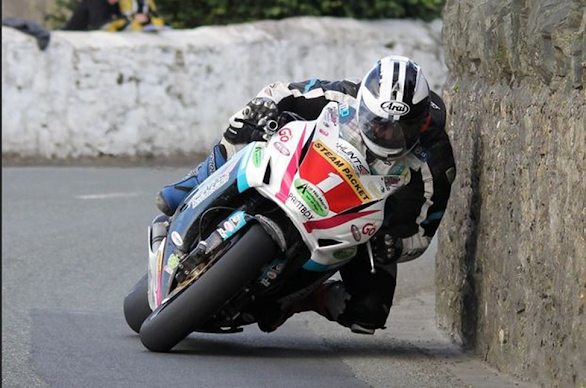
WEEKENDER: Isle of Man TT Races, by Wiggia


The TT races are a reminder of days gone by, an anomaly in today's motorsport calender that survives because people want it to. The TT races were the most prestigious in the GP calendar: it was the one race all wanted to win, to have on their CV.

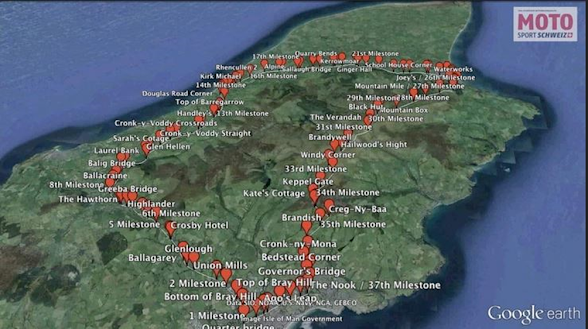
All the greats have been there, won and been remembered for some truly epic performances over the 37.73 mile course. Its landmarks are etched into the history of the races: the Bungalow, Union Mills, Kirk Michael, Quarter Bridge, Snaefell mountain road, and many more, the aficionados can quote them all. There are roughly two hundred corners on this circuit and sixty of them are named, no circuit in motor sport comes anywhere near. It is unique; the only competitor to its fame is the legendary Nürburgring in Germany which is a fourteen-mile motor racing circuit as opposed to the road racing one that is the TT course.

The race lost its status as part of the GP calendar after the 1976 event. This was largely because of a protest after the death of a rider in 1972. In many ways it was inevitable that safety concerns would eventually mean top riders and manufacturers would start to question the validity of this one race; the cost for the manufacturers of a race that was in length with practice almost a Grand Prix season on its own and the special technical provisos for this one race started to add up to a deficit against any gains for a win.

The changes on safety grounds to the course over the years have been continuous but you can never make a road course ‘safe’, it is just not possible, so the TT had to revert to a different formula to carry on. Remarkably it still has this magic appeal to the fans in its comparatively watered-down state, if you can call 133-mph laps watered down! What the lap times would be with full-blown Moto GP bikes is frightening but that is not going to happen.

The TT has seen the greatest of racing motorcyclists and the same with machinery. Many of today's manufacturers cut their teeth at the TT, none more so than Honda who came saw and conquered in a manner that few could have envisaged.

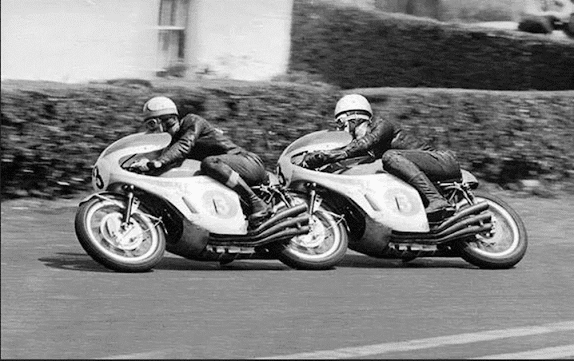
This one two-week race fest was the shop window to the world for the Honda manufacturers, and the new (to Europe) trade teams made full use of a moribund British motorcycle indusrty and cashed in, in spades. 1959 was their first appearance at the races in the 125cc and 250cc classes; they didn’t win individually but won the team prize. That sort of reliability was remarkable for an outfit on its first appearance. The advancement of their technology going forward was nothing short of amazing, finishing when they pulled out, temporarily, of GP racing with the ‘greatest’ racing motorcycle of all time, or certainly the equal of anything before or since: the six cylinder 250cc and the 305cc model that was capable of beating the current front runners in the 500cc class.

For the petrol heads the sound of the Honda Six can be sampled here - as someone once said, it’s like an air raid siren:


And the two works Hondas of Hailwood and Redman:


Since those heady days when the greatest riders competed on some of the greatest machinery on the world's most challenging circuit, the TT has clung on as an anachronism supported mainly by generations that remember the history and many riders whose holy grail is to ride the greatest circuit on earth. There is some truth in the latter: there is simply nowhere in motor racing that has a circuit anywhere near it in length and complexity and that of course has led to its downfall.

It is true you would have a job today to get the best of the world's riders to race there: they no longer do road circuits. For reasons of safety even the more interesting older circuits of some length such as the Nürburgring have been demoted from F1 and MotoGP partly on safety grounds and partly on TV viewing - those long circuits are difficult to cover and expensive, only Le Mans survives.


Will it continue? There seems to be no end to the number of riders who come from all over the world to test themselves against the mountain course, and it brings in a lot of bikers and others for the two weeks who in turn bring in a lot of revenue to the Isle Of Man.

No one needs reminding that all motor sport can be dangerous. Safety in track design and riders' equipment has made racing much safer in recent years, but at a cost: the circuits today have that sameness of character to such a degree that many are interchangeable and quite frankly boring. Silverstone, now for some reason our premier circuit despite having millions spent on it, is still an airfield at heart, a featureless bloody place - I know, I raced there - but money talks and better race tracks such as Brands Hatch and Donnington have been passed over.

The TT though goes on, for how long is anyone's guess. The sights and sounds of motorcycles going past your front door at 200 mph is a unique sight but an increasingly dangerous one. One cannot but think in this day and age, whatever one's leanings towards this two week jamboree on the greatest circuit on earth, that eventually someone or something will step in and say 'enough'. That will be a sad day but it has to be weighed against the death toll mounting year by year to what is now the population of a small village. Many riders it has to be said should probably not be racing there: too old, too inexperienced in this type of racing and in some cases just not good enough to take on on such a demanding course with all its dangers. The number who start in these races is much higher than a circuit race simply because they start in two’s at intervals so the size of the field is determined by the number who enter, not as elesewhere limited to the fastest 24 who qualify.

It may well be the ultimate challenge to race there but the question today is, is it worth it?


Since its conception the IOM races including the Manx Grand Prix later in the year has now claimed over 250 riders, three more this year as I write in the first week of racing. However much the adage ‘he died doing what he wanted to do’ is trotted out there is a limit when it becomes acceptable for so many to die. Yes it will be a very sad day when the plug is eventually pulled on this event, and there is no sign at the moment that is going to happen, but I think eventually it will; the memorials are running out of road, Better to remember what it was when it was the greatest motor cycle race in the world with the greatest riders all wanting to win and the manufacturers wanting the prestige. Despite the bravery of all who ride there today it is no longer the greatest and perhaps it should be let go before it is pushed.

That is only my opinion; the many who still go there and race there would tell me to 'do one' and I would accept that as I am aware where they are coming from; but time will tell, this carnage can’t go on. Nostalgia should not be enough for its survival.

Friday, June 10, 2022

FRIDAY MUSIC: Steeleye Span, by JD

Back on home ground this week with music from the incomparable Steeleye Span who, after more than 50 years of music making, sound as good as ever!

And they are still going strong - 

Monday, June 06, 2022

'Now and Next' - what you may have missed in May

Here are links to the inaugural pieces on Substack

There is a FREE email subscription service...


IQ - a right-wing issue? (May 15)
Academic ability is not always the biggest factor in employability; sometimes, a drawback!
 
IQ and racism (May 16)
Some right-wingers seize on IQ as a mark of racial superiority; the research and reasoning may well be flawed

Education and the crab bucket (May 17)
Stupidity is not the greatest barrier to achievement in schools

Did Russia engineer the 2014 Maidan protests 
to secure her gas exports? (May 19)
Something I mooted at the time...

Chinese real estate and superstition (May 20)
Why millions of Chinese apartments remain uncompleted

The Beach Master (May 23)
A fat rogue seal's search for love

Azov - it's only the start (May 24)
Russia's territorial objectives, and global warming

Double crisis: Ukraine and US leadership (May 25)
60 years on from the Cuban missile crisis, a repeat - but without a strong US President or stand-ins

The Tobacco Tin (May 31)
A visit to a tiny Cornish fishing village, and its artist

Sunday, June 05, 2022

SUNDAY SUPPLEMENT: Abstract Artwork by JD

"There is no abstract art. You must always start with something. Afterward you can remove all traces of reality." - Picasso

For no particular reason I thought I would post a few abstract paintings. They all began as something but rather than removing any trace of reality they just sort of evolved into something else.

... and an alternative quote from the maestro which is appropriate for this 21st century - "The world today doesn't make sense, so why should I paint pictures that do?"