We were in Ireland, up in the Galtee Mountains near Clonmel, where my wife's mother grew up. The holiday cottage had its own water supply, whose peat stain got through the filter on our water jug, and in the old fireplace we burned peat brickettes bought from the local garage. I love an open fire, and my motto for anything finished with is "it'll burn".
Peace, sunshine, fresh air. We should have bought a place there before the market went crazy.
I say fresh air, but the farmowner's dog (we called him Fogarty) could be detected going past a high window, by his crusted-cowshit smell. A genial animal, he would roll over when he saw us, displaying the impressive collection of scars on his belly and genitalia earned by jumping over barbed wire fences. Only the threat of sprayed hosewater would send him off on his way.
Morning. Breakfast over, the peat log dying to embers, my wife and her mother getting ready for the car ride into town to get their hair done. I tidied up and grabbed a crumpled paper tissue off the table and flung it on the fire. There's a delicious pause before paper darkens, then blooms into flame.
Only this time it was a blue flame. Wrapped in the tissue was a dental plate for the two false teeth my mother-in-law put on for show, though they weren't very good for the business of eating, which is why she had them out more often than in.
The flame brightened and elongated. It was far too late to save them.
She told the hairdresser, who collapsed, barking with laughter, then staggered across the passageway to the next shop: "Hey Jim, here's a feller burned the Mammy's teeth!"
I felt... accepted.
She passed away some years ago, but my wife says she's forgiven me by now.
Sunday, September 09, 2012

George Orwell and sham security
UPDATE
(15 September 2012): the camera has now been removed - I don't know why, or for how long.
 "In general you could not assume that you were much
safer in the country than in London. There were no telescreens,
of course, but there was always the danger of concealed microphones by
which your voice might be picked up and recognized..."
"In general you could not assume that you were much
safer in the country than in London. There were no telescreens,
of course, but there was always the danger of concealed microphones by
which your voice might be picked up and recognized..."
 "In general you could not assume that you were much
safer in the country than in London. There were no telescreens,
of course, but there was always the danger of concealed microphones by
which your voice might be picked up and recognized..."
"In general you could not assume that you were much
safer in the country than in London. There were no telescreens,
of course, but there was always the danger of concealed microphones by
which your voice might be picked up and recognized..."
George Orwell, Nineteen Eighty-Four.
Left: suburban Birmingham (UK), 9 September 2012
This camera was installed recently - and quietly - near to where I live.
Like so many things these days, it has its own little slogan: Making Birmingham Safer.
Not true. Last Sunday afternoon, the burglar alarm went off on a house across the road. I called the police, who told me they wouldn't come out unless I saw something suspicious; it could, after all, explained the policewoman on the other end of the line, have been triggered by a cat jumping onto a windowsill or something.
The response was much as I had expected, but I'd made the call to placate a couple of little girls who'd noticed the noise while trampolining in their garden next door.
When there's a real burglary, all you get is a crime number so you can claim on your insurance. And maybe a crime prevention pack from Victim Support officers who want to come in and eat your biscuits (I told them what I wanted was the burglars' heads cut off with a blunt knife, but their reaction suggested that my wish was inappropriate).
On the Monday, I returned from work to find a note through the door. It was from the police, asking for witnesses to an attempted robbery on our street on Sunday evening (c. 10:30).
No connection? Or would B not have happened if Birmingham's finest troubled themselves to deal in person with A, and show a regular physical presence in our area?
What use are cameras? Until burglars and muggers go around with numbers on their chests there'll be no flash-flash-you're-caught, like speeding motorists.
I suppose the police could upgrade to automatic face recognition software - but with all its Big Brother potential, that's a cure worse than the disease. Besides, criminals would find ways round: Andy McNab's novels explain how you go into a charity shop, buy a change of gear and put a peaked cap on your head and hey presto, cyber-following is foiled.
So what is all this? False reassurance, or an excuse to tighten the snooper's noose round the citizenry in general?
Or is it simply easier and safer for the cops to shuffle papers and handle calls from ninny householders who imagine we're still in an age when collars were felt, naughty kids' ears clipped and the bobby would tell you the time? Clock on, clock off and roll on retirement?
Saturday, September 08, 2012
Ripped off by pump prices
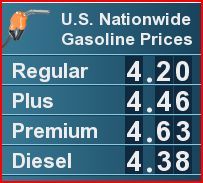
Americans complain about the high cost of fuel, but compared to us Brits they're sitting pretty. Below (left) is a snapshot of a widget found on Max Keiser's site, where you can check regularly and grind your teeth.
To convert from (US dollars per US gallon) to the current British equivalent (i.e. French Revolutionary decimal pence per French Revolutionary litre), simply divide by 6.
Or 6.058595, if you want to be more exact. Here's a sample based on the latest prices and exchange rates - Brits are paying almost exactly double:


INVESTMENT DISCLOSURE: Mostly in cash (and index-linked National Savings Certificates), but now planning to build up some reserves of physical gold via regular saving.
DISCLAIMER: Nothing here should be taken as personal advice, financial or otherwise. No liability is accepted for third-party content.
To convert from (US dollars per US gallon) to the current British equivalent (i.e. French Revolutionary decimal pence per French Revolutionary litre), simply divide by 6.
Or 6.058595, if you want to be more exact. Here's a sample based on the latest prices and exchange rates - Brits are paying almost exactly double:

INVESTMENT DISCLOSURE: Mostly in cash (and index-linked National Savings Certificates), but now planning to build up some reserves of physical gold via regular saving.
DISCLAIMER: Nothing here should be taken as personal advice, financial or otherwise. No liability is accepted for third-party content.
Ripped off by pump prices
Americans complain about the high cost of fuel, but compared to us Brits they're sitting pretty. On the right I've installed a new widget (found on Max Keiser's site) so you can check regularly and grind your teeth.
To convert from (US dollars per US gallon) to the current British equivalent (i.e. French Revolutionary decimal pence per French Revolutionary litre), simply divide by 6.
Or 6.058595, if you want to be more exact. Here's a sample based on the latest prices and exchange rates - Brits are paying almost exactly double:
To convert from (US dollars per US gallon) to the current British equivalent (i.e. French Revolutionary decimal pence per French Revolutionary litre), simply divide by 6.
Or 6.058595, if you want to be more exact. Here's a sample based on the latest prices and exchange rates - Brits are paying almost exactly double:
Tuesday, September 04, 2012
Food prices, speculation and eco-folly
Max Keiser is a joy, just a joy. In this latest broadcast he lays about him gleefeully, smacking "nay-sayers should commit suicide" Bertie Ahern and faux-libertarian followers of the Mises and Adam Smith Insitutes, and describing Rupert Murdoch as a failed, lifelong anti-competitive, octogenarian porn merchant who should just get out of the Internet's way.
But since I've been touching on food and land recently, I find Keiser's interview with Professor Yaneer Bar-Yam particularly intriguing. The prof published a report in May that finds corn prices in Mexico are three times higher than they would otherwise be, thanks to (a) the diversion of corn into ethanol production and (b) commodity speculation (legalised in 2000).
Here's the graph:

"Fig.1 Corn price (blue line) and curves showing the causes of price increases according to our quantitative model (red dashed line). The green dashed dotted line is the supply and demand equilibrium impacted by the demand shock due to increasing corn to ethanol conversion. The quantitatively modeled speculation contribution to prices is the difference between the total and the supply and demand curve. The corn price without ethanol shock or speculation would be essentially constant (black dotted)."
Similarly, financial greed converts into distress and hunger for the poor. And as Max and his colleague note, the investment "terrorists" think it's funny.
INVESTMENT DISCLOSURE: Mostly in cash (and index-linked National Savings Certificates), but now planning to build up some reserves of physical gold via regular saving.
DISCLAIMER: Nothing here should be taken as personal advice, financial or otherwise. No liability is accepted for third-party content.
But since I've been touching on food and land recently, I find Keiser's interview with Professor Yaneer Bar-Yam particularly intriguing. The prof published a report in May that finds corn prices in Mexico are three times higher than they would otherwise be, thanks to (a) the diversion of corn into ethanol production and (b) commodity speculation (legalised in 2000).
Here's the graph:

"Fig.1 Corn price (blue line) and curves showing the causes of price increases according to our quantitative model (red dashed line). The green dashed dotted line is the supply and demand equilibrium impacted by the demand shock due to increasing corn to ethanol conversion. The quantitatively modeled speculation contribution to prices is the difference between the total and the supply and demand curve. The corn price without ethanol shock or speculation would be essentially constant (black dotted)."
Similarly, financial greed converts into distress and hunger for the poor. And as Max and his colleague note, the investment "terrorists" think it's funny.
INVESTMENT DISCLOSURE: Mostly in cash (and index-linked National Savings Certificates), but now planning to build up some reserves of physical gold via regular saving.
DISCLAIMER: Nothing here should be taken as personal advice, financial or otherwise. No liability is accepted for third-party content.
Sunday, September 02, 2012
Food prices, speculation and eco-folly
Max Keiser is a joy, just a joy. In this latest broadcast he lays about him gleefeully, smacking "nay-sayers should commit suicide" Bertie Ahern and faux-libertarian followers of the Mises and Adam Smith Insitutes, and describing Rupert Murdoch as a failed, lifelong anti-competitive, octogenarian porn merchant who should just get out of the Internet's way.
But since I've been touching on food and land recently, I find Keiser's interview with Professor Yaneer Bar-Yam particularly intriguing. The prof published a report in May that finds corn prices in Mexico are three times higher than they would otherwise be, thanks to (a) the diversion of corn into ethanol production and (b) commodity speculation (legalised in 2000).
Here's the graph:

"Fig.1 Corn price (blue line) and curves showing the causes of price increases according to our quantitative model (red dashed line). The green dashed dotted line is the supply and demand equilibrium impacted by the demand shock due to increasing corn to ethanol conversion. The quantitatively modeled speculation contribution to prices is the difference between the total and the supply and demand curve. The corn price without ethanol shock or speculation would be essentially constant (black dotted)."
Similarly, financial greed converts into distress and hunger for the poor. And as Max and his colleague note, the investment "terrorists" think it's funny.
But since I've been touching on food and land recently, I find Keiser's interview with Professor Yaneer Bar-Yam particularly intriguing. The prof published a report in May that finds corn prices in Mexico are three times higher than they would otherwise be, thanks to (a) the diversion of corn into ethanol production and (b) commodity speculation (legalised in 2000).
Here's the graph:
"Fig.1 Corn price (blue line) and curves showing the causes of price increases according to our quantitative model (red dashed line). The green dashed dotted line is the supply and demand equilibrium impacted by the demand shock due to increasing corn to ethanol conversion. The quantitatively modeled speculation contribution to prices is the difference between the total and the supply and demand curve. The corn price without ethanol shock or speculation would be essentially constant (black dotted)."
Similarly, financial greed converts into distress and hunger for the poor. And as Max and his colleague note, the investment "terrorists" think it's funny.
Mountain high

From the ever-wonderful Dark Roasted Blend, a series of photos from the Himalayas (example above). Truly vertiginous, and reminds me of a series I watched about truckers who work in Alaska going for a busman's holiday along some of the world's other deadly routes. Plus Welsh comedian Rhod Gilbert and Greg Davies going through Nepal and literally up to the gates of China.
One of the things that make these areas so dangerous is that they are ever-decaying. In his 1958 travel book, A Short Walk In The Hindu Kush, Eric Newby describes a constant clattering of pebbles and rocks from the high places above.
But The Himalayas are still rising as the Indian subcontinent continues to crash into the Eurasian landmass, and the snowfields that created in Tibet gave rise to the great rivers that flow through and feed South-East Asia: the Indus, Sutlej, Ganges and Brahmaputra. I've often wanted to do the a sort of pilgrimage to that area, which in fact is an ancient site of worship centring on Mount Kailash.

The Himalayan range is young in geological terms, beginning about 65 million years ago - coincidentally around the time the dinosaurs died out. If only we could live long enough, and perceive slowly enough, to see the wandering of the continents about the globe:

And what of the future?:
Mountains are life-givers: without them, much less chance of rain and the fresh water that sustains us.
There is debate about how high a mountain can possibly be. The tallest from root to tip is Mauna Kea in Hawaii, but 60% of that is below the waves. The highest in the Solar System is on Mars and is some 72,000 feet - but that is in Mars' much lower gravity. This commentator says the theoretical limit on Earth is 90,000 feet, or about four times the height of Everest - but I think from what he says that you would have to include the depth of the tectonic plate on which the mountain stands.
Nevertheless, if the Tower of Babel had been completed and constructed as strongly as a mountain, it should easily have got among and even above high-level clouds. Breughel was right:

If the Babylonians had had the EU's translation facilities of Brussels or Strasbourg, they could have finished the building. Who knows what it would have looked like?
However, they tried to make it of brick, which in even the modern version of the material apparently can't make a wall higher than some 840 feet.
Mudbrick structures in Shibam, Yemen go up to nearly 100 feet; the Burj Khalifa in Dubai tops out at 2,717 feet; but the theoretical maximum is 10 - 100 kilometres.
It's even been suggested (see "technobot" comment #7 here) that a structure made out of diamond could stand 6-12,000 km high (they could get the material from this diamond star, I guess). Though there remains the question of economic rationale - whay you'd need to compress that much rentable space onto that base, and who could afford it (bearing in mind that land costs would be dwarfed by the expense of materials and labour).
And would any of them have the beauty of the real thing in Nature?
Wednesday, August 29, 2012
Mexico and drugs liberalization: a dark side?
Drug-takers and principled libertarians have welcomed the news that Mexico is to decriminalise drugs and close down the country's equivalent of the FBI. But behind it there may be more than the desire to reduce the horrifying death toll from gang wars.
There are disquieting rumours about newly-elected President Enrique Peña Nieto's personal life. His alleged gay lover, Agustín Humberto Estrada Negrete, claimed that Peña Nieto murdered his wife Monica Pretelini; her two bodyguards were subsequently killed while escorting the family, who were left unhurt; Negrete claims later to have been threatened, near-fatally assaulted and then fled to San Diego in California, from where he has continued to denounce his alleged former bedmate, as recently as last April.
There are also allegations of Peña Nieto's dealings with organised crime syndicates. It is even claimed that the latter helped fund his election campaign.
The winding-up of Mexico's "FBI" may not be merely a consequence of the drugs decision. Established in 2001, the Agencia Federal de Investigación (AFI) was tasked to fight not only organised crime but corruption. Reorganised in 2009 and renamed the Policía Federal Ministerial (PFM), it is said to have been penetrated by the gangs. But this is a danger for all intelligence organisations and not in itself sufficient reason for dispensing with them.
Is the President closing the PFM because it will no longer be needed, or because its own security is irredeemably compromised, or because if left in place it could eventually mount a full investigation into his own alleged activities?
As to the drug cabals, it remains to be seen whether legalisation stops the violence or instead steps it up as crime syndicates vie for control of the hugely lucrative industry prior to reincarnation as legitimate businesses.
There are disquieting rumours about newly-elected President Enrique Peña Nieto's personal life. His alleged gay lover, Agustín Humberto Estrada Negrete, claimed that Peña Nieto murdered his wife Monica Pretelini; her two bodyguards were subsequently killed while escorting the family, who were left unhurt; Negrete claims later to have been threatened, near-fatally assaulted and then fled to San Diego in California, from where he has continued to denounce his alleged former bedmate, as recently as last April.
There are also allegations of Peña Nieto's dealings with organised crime syndicates. It is even claimed that the latter helped fund his election campaign.
The winding-up of Mexico's "FBI" may not be merely a consequence of the drugs decision. Established in 2001, the Agencia Federal de Investigación (AFI) was tasked to fight not only organised crime but corruption. Reorganised in 2009 and renamed the Policía Federal Ministerial (PFM), it is said to have been penetrated by the gangs. But this is a danger for all intelligence organisations and not in itself sufficient reason for dispensing with them.
Is the President closing the PFM because it will no longer be needed, or because its own security is irredeemably compromised, or because if left in place it could eventually mount a full investigation into his own alleged activities?
As to the drug cabals, it remains to be seen whether legalisation stops the violence or instead steps it up as crime syndicates vie for control of the hugely lucrative industry prior to reincarnation as legitimate businesses.
Not so green: "eco" factors behind landgrabbing and food shortages
After Ethiopia (see yesterday's post), here's Friends of the Earth International on Uganda, and how land-grabbing and speculation is driven in part by high-minded attempts to find alternatives to oil, to get carbon credits and to "conserve"the environment. What a mess.
(Highlights in the excerpted text are mine.)

A number of different factors lie behind this phenomena. Many cash rich and land poor governments are trying to secure food supplies by buying land overseas for domestic supplies. Land and resource rich but cash poor governments are seeking foreign direct investment in land and agriculture. While many of the governments involved are seeking to expand their domestic production of food crops and crops for fuel, agribusiness is seeking to expand its operations and boost profits, growing more, more cheaply; growing new crops for new markets, particularly for agrofuels – as well as gaining access to new markets in rapidly developing economies. Investors and speculators are looking for good investment returns.
(Highlights in the excerpted text are mine.)

1.2 The demand for land
A number of different factors lie behind this phenomena. Many cash rich and land poor governments are trying to secure food supplies by buying land overseas for domestic supplies. Land and resource rich but cash poor governments are seeking foreign direct investment in land and agriculture. While many of the governments involved are seeking to expand their domestic production of food crops and crops for fuel, agribusiness is seeking to expand its operations and boost profits, growing more, more cheaply; growing new crops for new markets, particularly for agrofuels – as well as gaining access to new markets in rapidly developing economies. Investors and speculators are looking for good investment returns.
Governments
and private companies are both keen to gain access to fertile land at a low
cost. Rapid increases in the food prices in recent years left many governments
aware of their vulnerability to the market and eager to boost domestic food
supplies. Countries such as China, India and Egypt want to ensure they have
access to rice and grain. Other countries such as Saudi Arabia have recognised
that the changing climate and limited water supplies mean that some crops can
no longer be grown at home. Instead they are looking to outsource production to
areas where fertile land and water are in greater supply.
Land
grabbing for food has been recorded across Africa, notably in the Sudan and
Uganda; in Pakistan, in Cambodia; in Russia, the Ukraine and Georgia; and in
parts of South America, including Paraguay and Brazil. Some of these are
countries which struggle to feed their own populations – but which have enough
fertile land to attract foreign investors.
The
growing demand for vegetable oils in particular, driven by increased human
consumption and the promotion of agrofuels, particularly in Europe, has led to
expansion of industrial monocultures. The growing market for palm oil has seen companies
buying up land in tropical areas of Africa and Asia to establish plantations.
Similarly, soy has expanded in South America, and land has been grabbed for
jatropha in India, Indonesia and a number of African countries.
High
levels of demand for land have pushed up prices, bringing in investors and
speculators. With long term forecasts predicting increasing water shortages and
other climatic changes to agriculture, few expect the price of land to fall. As
a result, the big investment banks have moved into farming, buying up agricultural
land, livestock farms and processing plants.
Another
driver of land grabbing is particular types of environmental conservation
projects such as Reducing Emissions from Deforestation and Forest Degradation
in Developing countries (REDD) projects that generate carbon credits from plantations.
The appropriation of land and resources for environmental ends has been termed
as ‘green grabbing’ (Vidal, 2008). In many cases communities that have managed
and conserved forests for many generations are locked out of their communal
forest lands due to conservation needs. As plantations are accepted as forests
in international definitions, forested land is replaced by tree plantations
aimed at generating carbon credits for companies (FOEI, 2008).
Tuesday, August 28, 2012
John Company colonizes Ethiopia
Two recent themes on this blog have been (a) agricultural investment and (b) companies that are as powerful (and possibly as wicked) as governments.
How about the "resettlement" of 1,500,000 Ethiopians to make way for corporate agri-grab?
That story ran in January, but there's lots more on this long-running issue - just Google up "land seizure ethiopia" or similar. And it's happening across Africa.
If you need a current hook to hang it off, here's a Norwegian story reproduced on farmlandgrab.org. Google Translate will give you enough to get the gist, e.g.:
Nykolonialisering in the form of landrov may have different face from country to country. The common denominator is that topsoil has been the hottest investment item, after the housing market broke down. Money pursuit of profit. Investors know that food and topsoil is scarce. It is important to position themselves. Liberti citing an unnamed manager of a South American investment fund. He goes straight to the point at a conference for investors, "We need to stop beating around the bush.
Agroindustrielle big companies take croplands, water and markets away from farmers. We can sell our products at lower prices and undercut peasant family farms. It must make decisions which are also of political nature.The world needs an effective agricultural producing on a large scale.
But it is not possible to promote this model without any loses. "Many believe that everything is taken political decisions. Bond activist Henry Saragih from Indonesia is The Guardian hailed as one of the fifty people who can save the world. He says landrov is part of a agroindustriell model that is being promoted by the World Bank, IMF, FAO and the EU:
"On the basis of vaguely worded principles of" responsible investment in agriculture "legitimize these institutions actually broader violations of farmers' rights."
"... the World Bank, IMF, FAO and the EU": as an idealistic teenager/tweenie, I liked the idea of supranational government. Now, I begin to think that it, and the money-forces to which it allies itself, pave the way for an evil worldwide oligarchy. Just wait till they have no further need for ourselves. Meanwhile, Ethiopians are being turfed off like the Chechens under Stalin.
How about the "resettlement" of 1,500,000 Ethiopians to make way for corporate agri-grab?
That story ran in January, but there's lots more on this long-running issue - just Google up "land seizure ethiopia" or similar. And it's happening across Africa.
If you need a current hook to hang it off, here's a Norwegian story reproduced on farmlandgrab.org. Google Translate will give you enough to get the gist, e.g.:
Nykolonialisering in the form of landrov may have different face from country to country. The common denominator is that topsoil has been the hottest investment item, after the housing market broke down. Money pursuit of profit. Investors know that food and topsoil is scarce. It is important to position themselves. Liberti citing an unnamed manager of a South American investment fund. He goes straight to the point at a conference for investors, "We need to stop beating around the bush.
Agroindustrielle big companies take croplands, water and markets away from farmers. We can sell our products at lower prices and undercut peasant family farms. It must make decisions which are also of political nature.The world needs an effective agricultural producing on a large scale.
But it is not possible to promote this model without any loses. "Many believe that everything is taken political decisions. Bond activist Henry Saragih from Indonesia is The Guardian hailed as one of the fifty people who can save the world. He says landrov is part of a agroindustriell model that is being promoted by the World Bank, IMF, FAO and the EU:
"On the basis of vaguely worded principles of" responsible investment in agriculture "legitimize these institutions actually broader violations of farmers' rights."
"... the World Bank, IMF, FAO and the EU": as an idealistic teenager/tweenie, I liked the idea of supranational government. Now, I begin to think that it, and the money-forces to which it allies itself, pave the way for an evil worldwide oligarchy. Just wait till they have no further need for ourselves. Meanwhile, Ethiopians are being turfed off like the Chechens under Stalin.
Subscribe to:
Posts (Atom)